The Pendant Hunt
The first thing this project ever shipped wasn't a chapter — it was a mark. Two boards of Midjourney, one stubborn idea, and the reason the cracks stayed.
Before I share a single chapter with you, let me show you the first thing this project ever shipped: a stone.
Quick backstory, because I want you to know how this actually works. I write this book inside a little app that sits in my Mac's dock — me and my amanuensis. That's an old word for a writing companion: the one who takes dictation, keeps the manuscript straight, argues with you about timelines. Mine happens to be an AI, and I like the old word a lot better than the new ones — you can meet him properly at that link. The app needed an icon. The site you're reading needed a mark for the browser tab. So before the book had a public page to its name, the hunt was on.
I knew right away what the mark had to be. Not a logo — the object itself. The heirloom Ada turns between her fingers at 2:47 AM: a stone too old to work, that works anyway.
We wrote down three rules before touching Midjourney. It has to read as ancient before it reads as anything else. It has to be warm — one light source, glowing from the inside. And it has to suggest technology without a single pixel of chrome, glass, or neon, because the moment it looks like sci-fi hardware, the book it belongs to becomes a different book. Those three rules grew into a style guide that all the art now answers to. We call the feeling warmth in the dark: a cold abyssal field holding one warm light. Once you see it, you'll see it everywhere on this site.
The first board ran seven different strategies for the same object — a flat mark, a carved sigil, a fully rendered artifact, a museum photograph, a negative-space mark, a star map, and one wildcard, because you always leave room for a wildcard. Running seven directions at once sounds wasteful. It's the opposite — it's the cheapest way to find out which direction the idea actually wants. The verdict: the rendered versions and the museum shots came back looking like beautiful, expensive jewelry. Wrong. The flat marks held up at sixteen pixels, which is where an icon lives or dies.
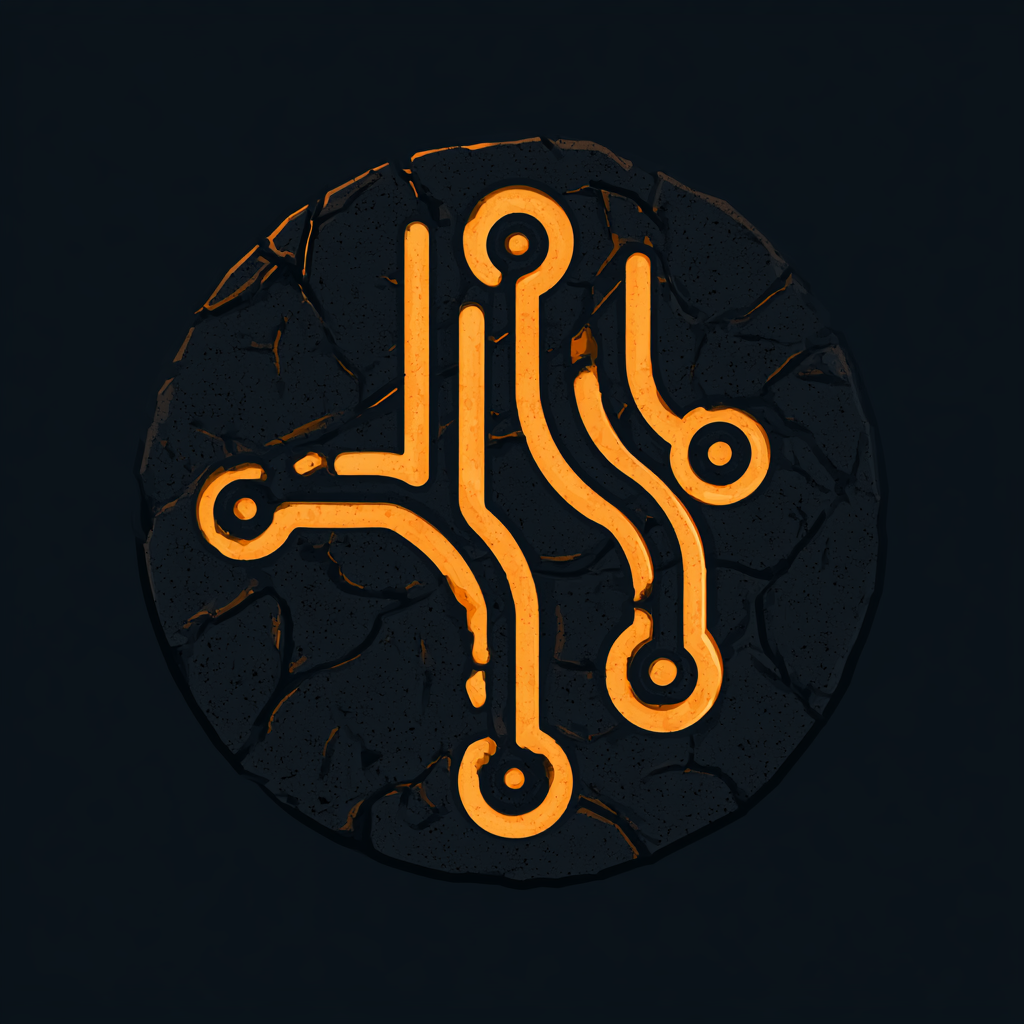
Round two narrowed to three directions, with every image numbered so we could talk about candidates by name instead of pointing at thumbnails. The winner came out of direction E:
dark cracked stone disk carved with three bold rounded channels and small dot nodes, glowing warm amber, flat minimal icon, thick confident lines, navy ground, generous margin --ar 1:1 --raw --s 50 --no fine detail, gradients, text, watermark
Look at the channels. They branch like a root system, or a river delta, or a motherboard — all three at once, and that is exactly the ambiguity this story needs. The carving reads as writing first and circuitry second. Ada would send samples of this thing to six laboratories. Honestly, so would I.
So that's the mark — in my dock, in your browser tab, at the top of this page. Cracks and all, because a thing that old should be broken, and still working.
One question stayed open: does the book's cover get this exact artifact, or only its light? That one's parked for now — cover season will come, and you'll be here for it.